May 18, 2026
Recipe for Wine Brandy Production
May 18, 2026
Wine brandy is a strong alcoholic beverage produced by distilling wine and aging the wine distillate. The quality of wine brandy is influenced by the following factors: grape variety, climate, soil, method of vine cultivation, vine protection, method of processing grapes into wine, method of wine distillation, and method of maturation, or aging, of the wine distillate.
Early and Muscat varieties that produce strongly aromatic wines are not suitable for wine brandy. Varieties that ripen later are more suitable for this production, without a pronounced aroma or with only a barely noticeable aroma, and which, with a high yield, produce grapes low in sugar and rich in acids. Grapes produced in a moderate climate, where they can ripen normally, are best suited for wine brandy. The highest-quality wine for wine brandy is obtained from grapes grown on limestone soil, followed by stony and clay soils.
Wine intended for distillation, when made from white grape varieties, should be light yellowish in color, while wine from red grape varieties should be light pink. The aroma of wine brandy depends largely on the oak used to make the barrels and on the years of aging. When a distillate is obtained from wine, it initially has a rough and sharp aroma. Oak gives wine brandy its character, and the longer it remains in barrels, the more drinkable, harmonious, softer, and naturally higher in quality it becomes. Experts say that the best oak for barrels is more than 40 years old, or even better, 80 years old.
TECHNOLOGICAL REQUIREMENTS
The grapes must be technologically ripe, but not overripe. The most objective measure of grape quality is the ratio of sugar to acids. Sugar should be in the range of 14 to 18%, while total acidity should be above 8 g/l. A “discreet aroma” of the grapes is also desirable. Grape yields should not be too high, but also not too low.
Oxidation of ascorbic acid occurs in overripe grapes, and ascorbic acid, or vitamin C, protects the aromatic substances of the wine that later pass into the distillate.
During crushing and destemming, the stems should be removed, and during alcoholic fermentation the tannins should not exceed 0.2 g/l.
For high-quality wine brandy, distillation must take place immediately after the first racking of the wine.
Through distillation, the primary goal is to separate as much alcohol as possible from the raw material, wine, with as few undesirable impurities as possible. Undesirable impurities are mainly found in the tails fraction. By separating the foreshots and tails from the middle fraction, we obtain a distillate with fewer undesirable impurities.
Most impurities, especially those with the strongest smell, such as aldehydes, esters, and higher alcohols, pass into the distillate in the first fraction. By separating them, a significantly better quality brandy can be achieved.
With modern continuous distillation equipment, if equipped with dephlegmators and rectification columns, the technologist can influence the quantity and quality of impurities in the distillate.
At the beginning of distillation, aldehydes and easily volatile esters mostly pass into the distillate. In the middle stage, components pass over in a ratio that is favorable for distillate quality, while toward the end of distillation, less volatile components with a tails-like aroma and volatile acids pass over.
These principles are used in the distillation process, which is why the foreshots and tails are separated from the middle, highest-quality fraction, because they contain components that generally do not contribute to quality.
First, wine distillation produces a raw wine distillate with an alcohol strength of 25 to 32% vol., which is then redistilled to obtain a distillate with an average strength of 60 to 72% vol. alcohol. During redistillation, the foreshots are separated in an amount of 1 to 1.5% of the volume of distillate in the still, while the tails fraction is separated from the moment when the strength of the distillate at the outlet of the cooler drops to 45 to 40% vol.
When similar distillation apparatuses are equipped with a dephlegmator, a distillate of the required strength can also be obtained by direct wine distillation.
Distillation should begin immediately after alcoholic fermentation is complete and should be finished by the beginning of May, so that this low-alcohol and unsulfured wine does not spoil during the warm summer days.
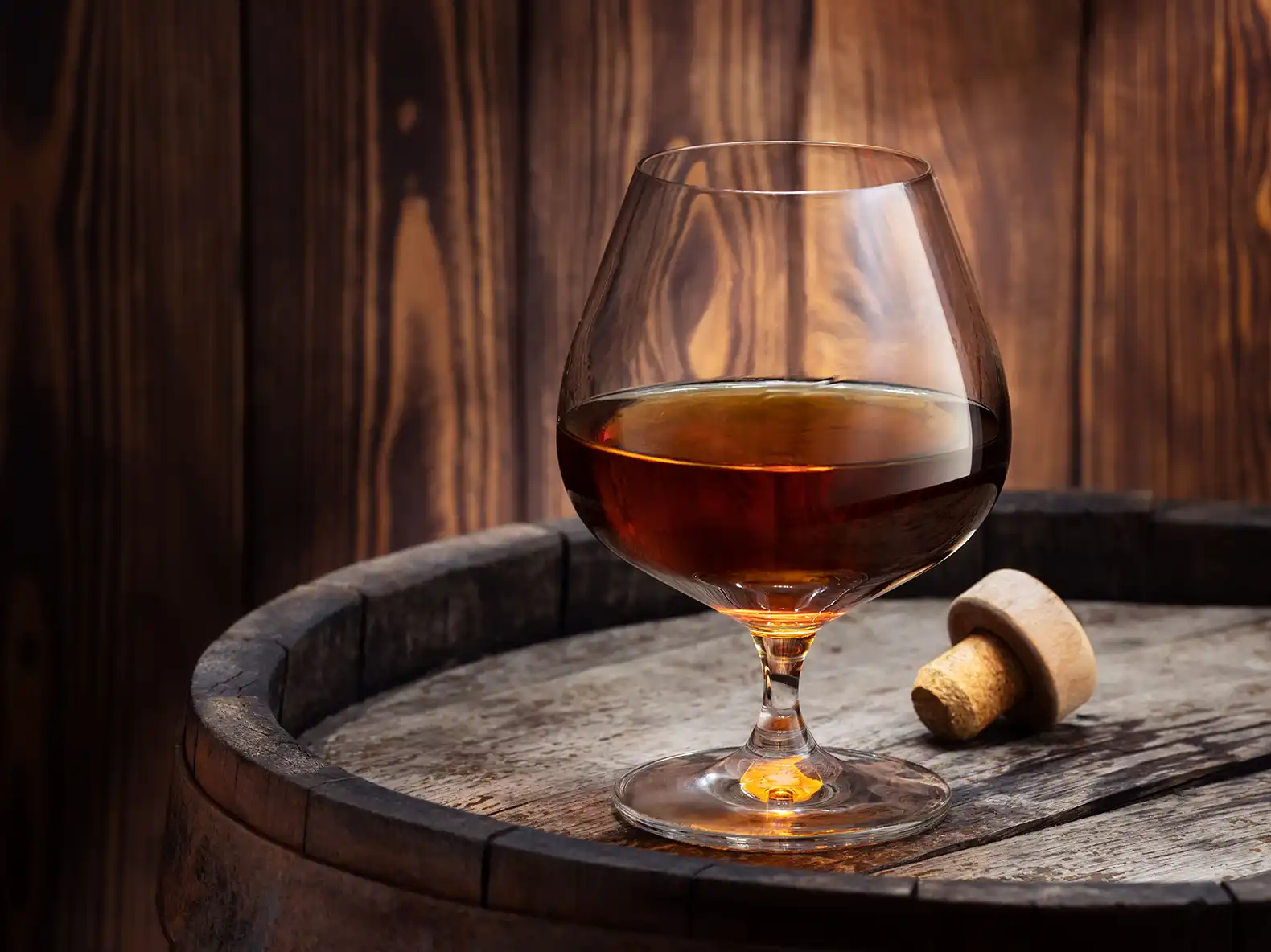
The new wine distillate is placed into new oak barrels, previously rinsed with superheated steam and cold water in order to remove excess harsh components. The distillate remains in new barrels until it obtains a golden-yellow color and the required amount of tannin and lignin substances, after which it is transferred into old barrels, where it remains until the aging process is complete.
These processes are very complex and slow, and they change both the primary components of the distillate and the secondary components originating from the oak staves. The more important changes occur under the influence of oxygen from the air, in the presence of activators and catalysts, as well as through the mutual interaction of all components present.
Since wine distillate contains significantly more alcohol than is required for wine brandy, it is diluted, most often with distilled water. Sudden dilution of the distillate negatively affects its quality, which is why dilution is carried out gradually during aging. Even so, the distillate still needs to rest for several months at its final strength.
Wine brandy is usually supplied at 38 to 45% vol., most often at 40% vol. alcohol.