May 19, 2026
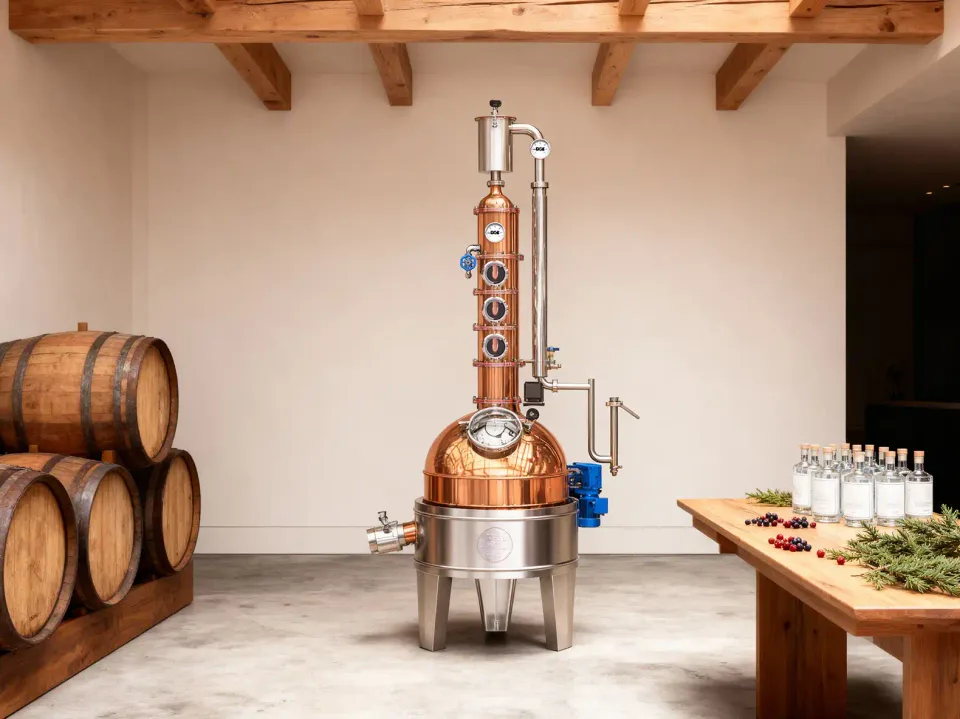
Read MoreHow to Choose the Right Still for Your Needs: A Guide for Distillers
Choosing the right still is essential for your distillery, whether you are starting with hobby production or planning a serious business. The right choice can mean the difference between enjoying the craft and dealing with unnecessary costs and difficulties.
First of all, good planning is necessary. What do you want to produce, in what quantity, and do you have enough space? Once you have considered all of this, it is necessary to define the batch size you want to ferment, if you are producing a distillate from fermentation. Do not think that gin producers have it easier. What is saved on fermentation is often offset by longer distillation cycles due to the higher initial alcohol concentration. Once you have defined the batch quantity, you define the working day, 8 / 16 / 24 h. Only then can you determine what size of still you need.
Here is a practical example:
We want to produce plum brandy. We have enough space in our distillery for 10 t. We decide that we can work 16 h once fermentation stops. Now we begin to consider which still suits us best. If we can form fermentation batches with a day or two between them, we arrive at a mass of 1 t, that is, approximately 1000 L per day, which we need to process once fermentation is complete. If we are familiar with the distillation times for fermented mash, which can easily be seen on our website, we come to the conclusion that a 200 L still suits us best, because it can easily complete 5 cycles in that time. Since we also perform double distillation, we must take into account that 4 to 5 still charges of fermented mash are needed to obtain one still charge for double distillation. This means that in any given year, we should not process less than 800 to 1000 kg of fruit.
In this case, only if we predict production growth over the next 10 years should we consider purchasing one additional 120 L still, or starting immediately with a more expensive, larger still of 350 or even 500 L, with an adjustment of the batch size.
The type of still, traditional or modern column still, which also includes the option for traditional distillation, is determined by the range of distillates you intend to produce. Young distilleries often have several different distillates in their offer in order to strengthen their market presence. Such a range requires a versatile still that can produce distillates in a high-quality and efficient way.
Finally, there is the heating method. Today, energy prices vary, and our advice is to choose the energy source that is most accessible and favorable to you, while respecting environmental measures as much as possible. Fortunately, our traditional-type devices can be heated using multiple energy sources, and in some models even by combining two energy sources.
May 18, 2026
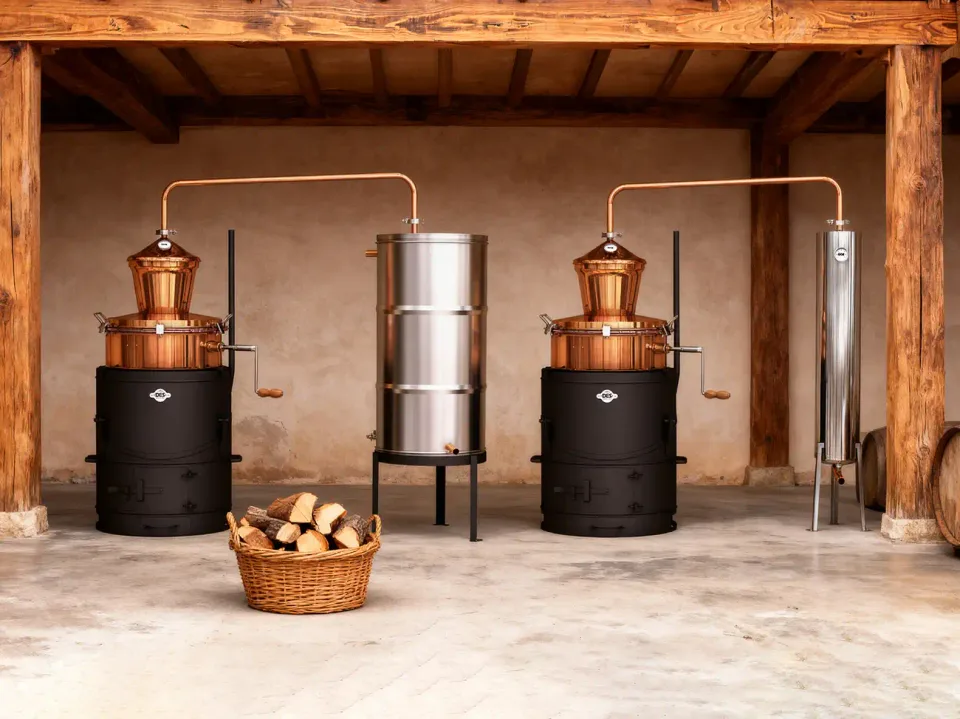
Read MoreHow to choose cooler: Classic Cooler or Flowing Cooler?
In distillation, the cooler is almost as important as the still itself. It is the place where vapor meets cold water and where aromatic vapors are transformed into the final distillate. If you are wondering which cooler suits you better, the classic cooler or the flowing cooler, we will explain it simply below.
The classic cooler is made of galvanized steel. Vapor from the still passes through a copper coil immersed in a vessel filled with cold water, and this water is periodically replaced or topped up in order to remain cold. The drawback of the classic cooler is that, due to its larger volume, it consumes more water, and when working with larger quantities, it can operate more slowly compared to flow-through coolers. The quality of the obtained distillate is the same, but more effort is required to regulate the temperature of the distillate. The advantage of this cooler lies in user habits, and habits are difficult to change.
On the other hand, the flowing cooler is made of stainless steel. It works by continuously allowing fresh cold water to enter the cooler, while the heated water is discharged through a drainage hose. Vapor passes through a tube system surrounded by cold water at the appropriate temperature. The water flow is adjusted using the installed valve, the optimal cooler temperature is 40–60 degrees, and the temperature of the outgoing distillate should certainly also be monitored. This allows the distillate to be cooled more efficiently and continuously, which is especially important with larger stills.
The flowing cooler cools evenly, enables precise control of the cooling temperature, requires a constant and regulated water supply, and has a capacity of 30 liters, providing significant water savings.
May 20, 2026
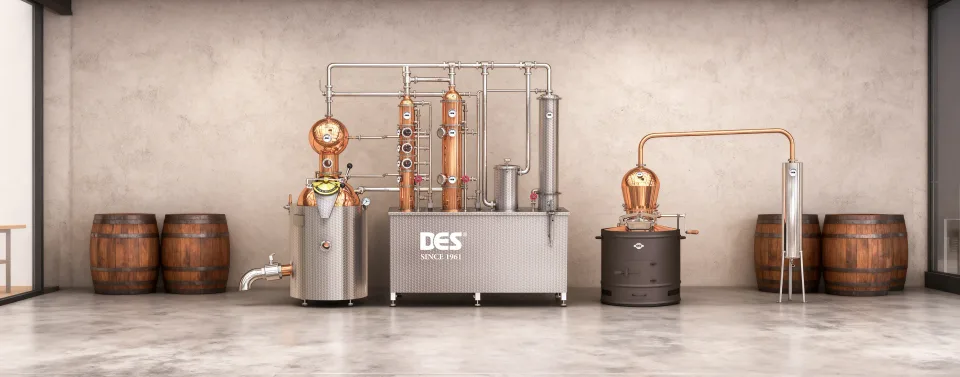
Read MoreThe Difference Between Traditional and Modern Stills
Modern distillation does not replace tradition. It makes it more efficient, more precise, and more reliable.
In the classic, traditional process of brandy production, double distillation is often required. This means more time, higher energy consumption, and additional involvement during production. Its greatest advantage is precisely tradition, the taste and style of distillate that many consumers are already used to and remain loyal to.
A modern still brings a different approach. Using the example of a 500-liter DES still with two columns, homemade plum brandy can be distilled with the help of the Aroma Max column, which preserves and transfers the natural fruit aroma into the final distillate as much as possible, while enabling a faster, cleaner, and more efficient production process.
Process example
Distillation lasts around four and a half hours, and the process is stopped at approximately 55% vol. The result is around 25 liters of finished distillate.
The key difference is that:
there is no need for double distillation,
energy is not consumed twice,
there is no manual washing, thanks to the built-in automatic CIP system,
there is no scorching, because the heaters heat the water, and the water then heats the mash evenly.
The biggest benefits are clear:
significant time savings, lower energy consumption, and high distillate quality.
Modern technology does not change tradition.
It improves it.
DES, the next level of distillation.
May 20, 2026
Read MoreSafe Distillation, What to Pay Attention To
Distillation is an art, but also a serious technical process involving high temperatures, flammable vapors, and pressure. That is why, regardless of whether you are a hobby distiller or run a professional distillery, safety must come first.
In this guide, we will share key tips on how to make distillation safe while achieving top-quality results.
High-quality and properly functioning equipment, the foundation of safety
Use only properly functioning stills and condensers made from materials suitable for food contact, such as copper and stainless steel.
Regularly check for cracks, worn edges, or blocked pipes.
Do not use improvised equipment, as it can lead to vapor leaks and fire hazards.
Ventilation of the space
During distillation, alcohol vapors are released and they are highly flammable.
Always carry out distillation in a well-ventilated space or outdoors.
Avoid enclosed spaces without ventilation, as vapor accumulation can lead to explosion or poisoning.
Avoid open flames near vapor
Alcohol vapors can ignite even at a short distance from a heat source.
If you use gas-fired or solid-fuel stills, make sure the flame is isolated from any possible vapor leaks.
For maximum safety, consider electric heating, which allows more precise temperature control and reduces risk.
Temperature control
Excessively high temperature can lead to overheating of the mash, sudden boiling, or reduced and damaged aroma quality of the distillate.
Use thermometers to monitor the process.
Do not exceed recommended values, slower and controlled distillation gives safer and higher-quality results.
Careful separation of fractions
The first part of the distillate, the foreshots, contains methanol and other harmful substances.
Always separate and discard the first 0.5–2% of the distillate volume.
Proper separation of the foreshots, heart, middle fraction, and tails is not only a matter of taste, but also of safety.
Working with alcohol, gloves and safety glasses
When cleaning and filling the still, as well as when handling strong alcohol, wear protective gloves and safety glasses. Alcohol in concentrations above 60% vol. can cause skin and eye irritation. This mainly applies to people who are sensitive.
Fire extinguishing and emergency situations
Always keep the following near the workplace:
Fire extinguisher, class B, for flammable liquids
A bucket of sand for quickly extinguishing flames without spreading vapors
Access to water for cooling equipment, not for extinguishing alcohol!
Safety
Safety in distillation is not an “option”, it is a rule. By following basic procedures, using high-quality equipment, and controlling the process, you not only protect yourself and the space in which you work, but also ensure that your distillate is of top quality.
And when you work with DES stills, you can be sure that every element is designed with durability, efficiency, and above all, safety in mind.
May 20, 2026
Read MoreDES 500 L Still with Column, Precision for Premium Gin
Do you think gin is just flavored vodka?
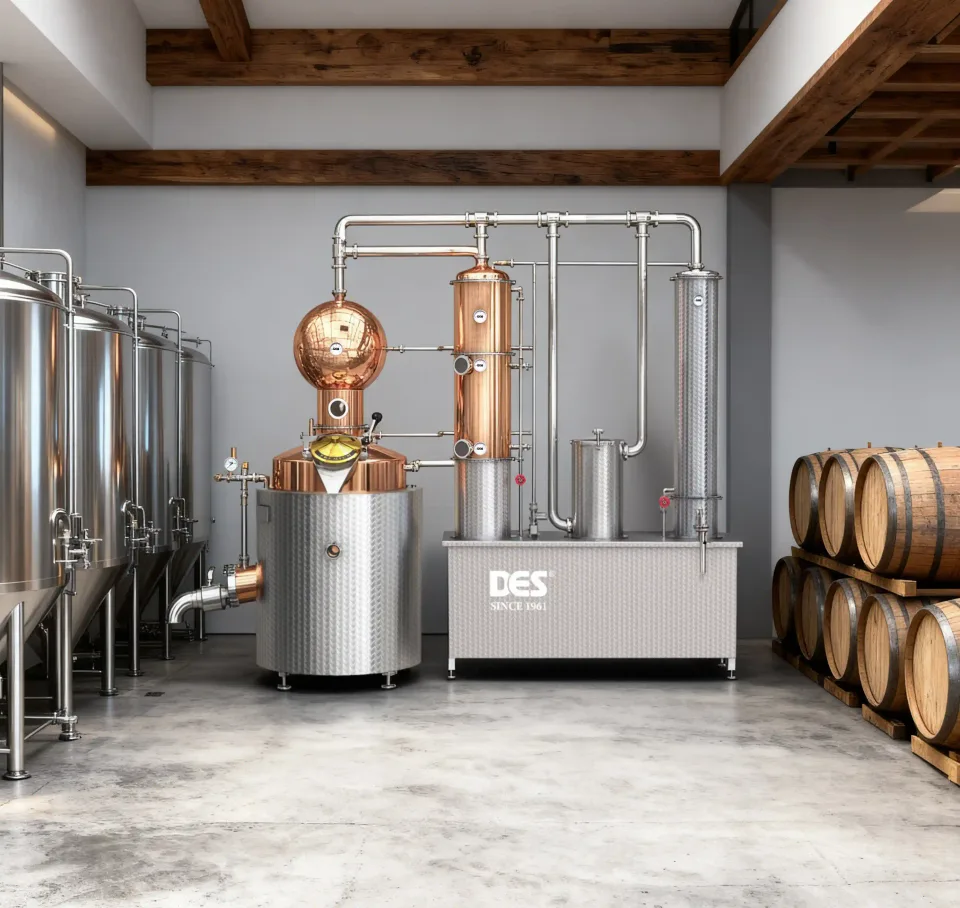
Real gin is made much more carefully, through a precisely managed distillation process, aroma control, and equipment that enables consistent quality. This is exactly the type of production the DES 500-liter still with column is designed for.
This system enables the preparation of an alcohol base, the addition of carefully selected botanicals, and controlled redistillation, making it an excellent choice for premium gin production. Botanicals such as juniper, coriander, anise, angelica root, cinnamon, and other spices are added to the prepared base, while additional aromas can be placed in the aroma basket, together with dried citrus peels, in order to achieve a more pronounced and layered aromatic profile.
Gin distillation example
We start with 235 liters of alcohol at 96% vol. We add 265 liters of water and obtain 500 liters of base at 45% vol.
Additional aromas are also placed in the aroma basket, together with dried citrus peels. Heating is carried out in a controlled manner, up to around 85°C. The heaters are gradually switched off at 60, 70, and 85°C. We select the column, keep the reflux in the middle position, and monitor the temperature on each plate. For gin, the foreshots are separated at around 0.5% of the total volume, or approximately 2.5 liters.
Distillation is carried out moderately. We do not rush, because quality does not like speed. The process is stopped at around 50% vol., so that unnecessary essential oils are not collected.
The result is around 180 liters of distillate at 82% vol. After dilution, approximately 370 liters of finished gin at 40% vol. are obtained.
The DES 500 L still with column is not just equipment, it is a reliable production tool for distilleries that want greater control, repeatable quality, and serious capacity.
DES, stills from 1 to 6,000 liters for the production of all types of distillates.
May 18, 2026
Read MoreHow Much Does Copper Thickness Affect the Quality of Distillate
This is a topic that often sparks debate among people who distill spirits. There is almost always someone who insists that thicker copper is the key to better quality and that without it, good fruit brandy cannot be produced. At first glance, this seems logical stronger material should lead to a better result. However, when you look a little deeper, it becomes clear that things are not quite that simple.
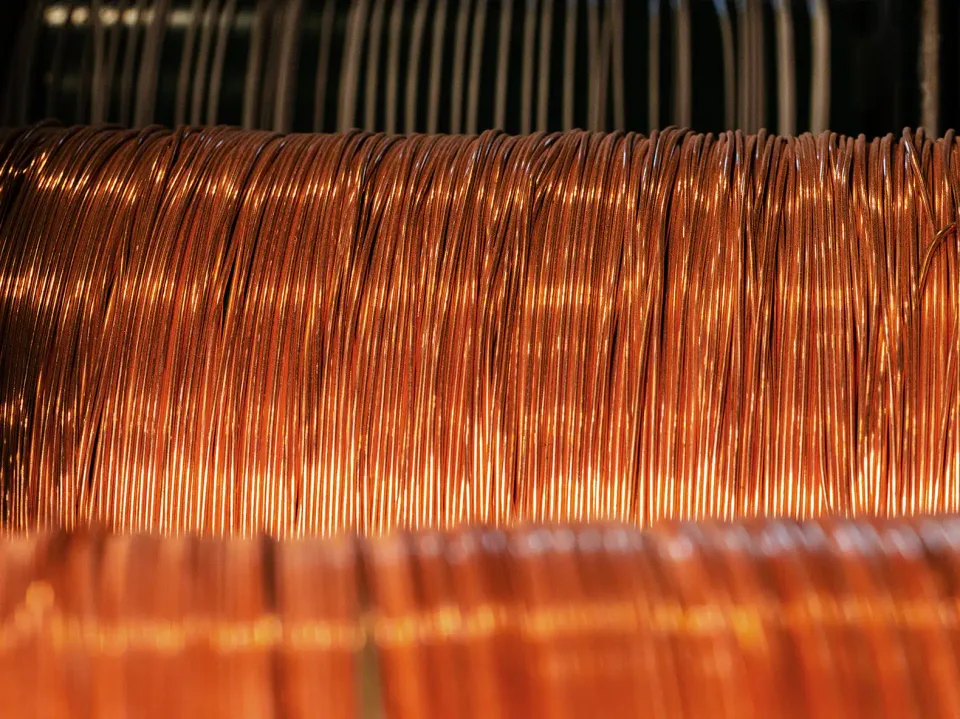
The truth is that the thickness of the copper itself does not directly influence the quality of the distillate. What truly makes a difference is copper as a material, because it has the ability to bind undesirable compounds from the vapor and therefore improve the aroma and flavor of the spirit. However, the vapor does not “know” whether the wall of the still is two or five millimeters thick. It only comes into contact with the surface, not the thickness of the material. For this reason, it is incorrect to believe that a thicker copper will automatically produce a better spirit.
One of the biggest mistakes people make is confusing the quality of the still with the quality of the spirit. A thicker copper still is indeed a higher-quality piece of equipment—it is more stable, more durable, and easier to work with. However, that does not mean it will produce a premium spirit on its own. If the mash is poor, if the fermentation is not properly managed, or if the fractions are not separated correctly during distillation, no amount of copper will fix that. The still is simply a tool, and the final result depends on the person using it.
Copper thickness becomes important primarily when the still is used frequently. For those who distill at home for their own needs, stills made with thinner copper are absolutely suitable. For those whose needs are significantly larger—such as service distillers or producers processing large volumes—an appropriate increase in copper thickness is necessary to support that level of use.
In the end, when everything is considered, it can be said that copper thickness does not directly increase the quality of the spirit, but it does reduce the likelihood of making mistakes. And that may be one of the most important aspects of the entire process. The real question, therefore, is not whether the copper is as thick as possible, but whether the still is well built and used correctly.