May 20, 2026
Brasserie Distillerie Guyenne: French Vermouth, Craft Spirit, and a DES Still
May 20, 2026
In an old wine region near Bordeaux, inside a former wine cellar, beer, distillates, botanicals, grains, and the ideas of three friends who turned a hobby into a serious craft project come together today.
Brasserie Distillerie Guyenne, located in Lugasson, in the Entre-deux-Mers region, is developing a production that does not fit into just one category. Their portfolio includes beer, gin, pastis, vermouth, rum, vodka, and whisky, and this very breadth shows how important it is to have equipment that can follow different styles, raw materials, and processes.
They recently received special confirmation of quality through high scores for their vermouths, 93 points for Vermouth Blanc and 90 points for Vermouth Rouge. For a producer coming from a region strongly connected to wine, such recognition carries special weight, because vermouth requires exactly what French craftsmanship is known for, a sense of measure, aroma, and balance.
Three friends, one idea, and many aromas
Brasserie Distillerie Guyenne was founded by François, Hugo, and Arnaud, three friends connected by shared passions: good drinks, craft production, entrepreneurship, and respect for the environment. Their story, as they describe it themselves, began with conversations in the locker room after basketball, continued through whisky tastings in a garage, amateur beer brewing, and the desire to turn a hobby into serious production.
Today, that initial enthusiasm has taken a concrete form. Guyenne produces drinks that carry local character, but also a clear ambition to become part of the modern French craft distilling scene.
Their philosophy can be summed up in one thought: aroma is not a detail, aroma is the essence.
Vermouth as a blend of wine, botanicals, and precision
Vermouth is a particularly interesting product because it stands between the world of wine and the world of strong alcoholic spirits. It requires balance. It needs a wine base, carefully selected botanicals, good maceration, precise aromatization, and a sense of measure.
With vermouth, there is no room for excess. If the aroma is too weak, the product remains flat. If it is too strong, it loses elegance. If the balance is not right, what makes vermouth special disappears.
That is why the high scores received by Vermouth Blanc and Vermouth Rouge represent an important confirmation of their work. It is not only recognition for one product, but proof that Brasserie Distillerie Guyenne understands the complexity of a drink where wine, botanicals, bitterness, freshness, and structure meet.
The DES still as part of a broader production story
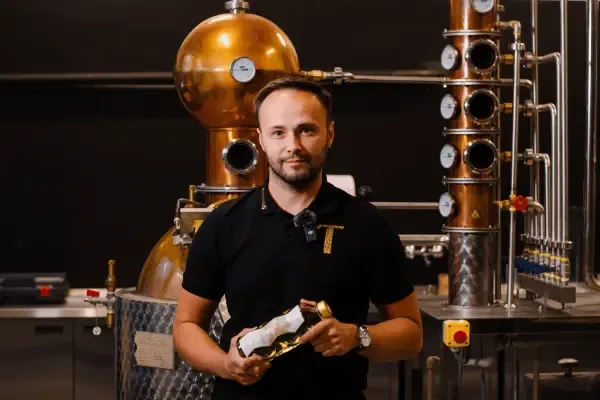
What makes this story especially important for DES is the fact that Brasserie Distillerie Guyenne uses a 500-liter DES hybrid still. According to the publicly available producer description on the Kouer platform, they are equipped with a DES alembic, as well as their own brewing equipment, which allows them to carry out key production stages within the distillery itself.
This kind of equipment gives them the flexibility that is crucial for producers with a broad portfolio. When a distillery develops different categories of drinks, from vodka and rum to whisky and vermouth, the still must provide stability, control, and the ability to adapt to the process.
For vodka, purity is important.
For rum, the character of the raw material and work with the aromatic profile.
For whisky, a stable beginning to a long maturation process.
For vermouth, a sense of aroma, balance, and precision.
That is why a modern still is not just a piece of equipment. It is the foundation on which a producer builds different directions of their identity.
From beer to whisky, all under one roof
Guyenne is not a classic distillery that produces only one category of drinks. Their production develops in several directions. On their official website, they list gins, pastis, rhum, and whisky as part of their project, while their online shop also includes vodka, beer, vermouth, and other drinks.
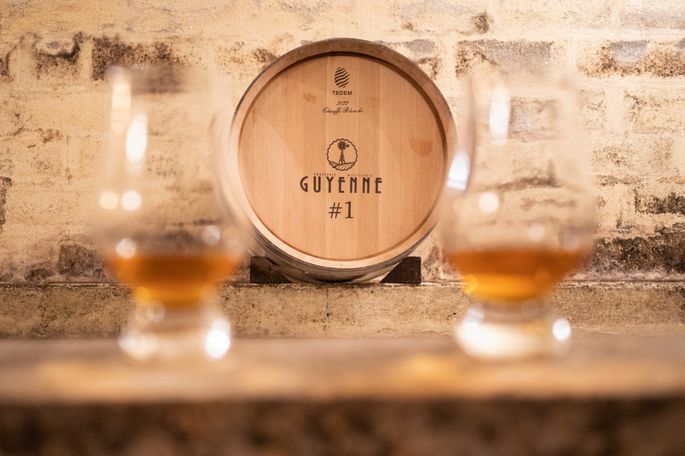
Their work on whisky is especially interesting. According to available information, whisky production began in 2023, and the first whisky is planned for release during 2026, after the required maturation period in barrels.
This shows the seriousness of their approach. Whisky is not a product that can be rushed. It requires time, discipline, and trust in the process. That is exactly why it is important to set the foundation properly, from raw material, through distillation, to aging.
Why flexibility matters for modern distilleries
Today’s craft distilleries often do not want to be tied to only one product. They explore, test, develop small batches, follow market reactions, and build their own style across multiple categories.
Brasserie Distillerie Guyenne is an excellent example of such an approach. Their portfolio shows breadth, but not as random variety, rather as an exploration of aromas and techniques.
This kind of work requires equipment that can follow the producer’s idea. DES modern stills enable exactly that, a controlled process, reliable operation, and adaptation to different types of distillates.
A good still does not define the identity of the distillery instead of the producer.
It enables the producer to express their identity more precisely.
What does this story mean for future distillers?
The story of Brasserie Distillerie Guyenne shows that high-quality equipment is not important only for large distilleries or for producers of a single type of drink. It is just as important for creative producers who want the freedom to explore.
If you are planning to produce several categories of drinks, it is important to think from the very beginning about a still that can follow different processes. Vodka, rum, whisky, gin, vermouth, liqueurs, and other drinks require different approaches, but at the foundation of every good production are control, stability, and repeatability.
DES stills are used around the world for the production of brandy, gin, absinthe, liqueurs, vodka, rum, whisky, and other alcoholic spirits. Our range includes more than 40 still models, different types of columns, several heating options, and the possibility of custom production according to production needs.
For producers who want to develop an authentic portfolio, the right still is not only an investment in equipment. It is an investment in creative freedom.
French craft, modern distillation, and a clear idea
Brasserie Distillerie Guyenne shows what it looks like when friendship, knowledge, and a passion for aromas turn into a serious production project.
From an old wine space in Lugasson, near Bordeaux, come drinks that combine the French sense of terroir, craft curiosity, and modern distillation technology. Their vermouth is already receiving high scores, their whisky is maturing, and their portfolio continues to develop across different drink categories.
For DES, it is a special honor that our still is part of their production story.
Because when a producer has a clear idea, good raw material, and equipment that can follow their ambition, the result is not just another drink on the market.
The result is a recognizable style.
Contact us and find the DES still that suits your production.